









 BOOKS
BOOKS In Which We Take Refuge In Poetry
Thursday, June 18, 2009 at 5:00PM 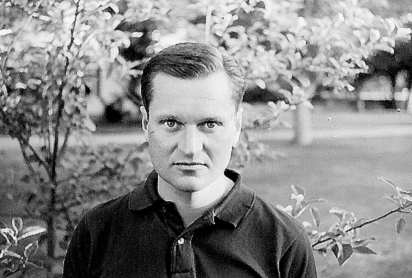
An Interview with Harry Mathews
by JOHN ASHBERY
read the full interview here
John Ashbery: One is supposed to ask questions about a writer's work, but I thought I would ask you about your life, which I know very little about. As so often with one's nearest and dearests, their biographies have enormous lacunae in them. I don't know, for instance, very much about why you went to Harvard when you did, or why you left it. I don't know why you studied music. I don't know why you went to Majorca. If I knew, I've forgotten all these things.
Harry Mathews: I think it's very kind of you to assume why I did any of these things. I went to Harvard because I disliked Princeton so much - I spent a year and a half there. I didn't leave Harvard early; I actually finished. I think I did two years in a year and a half, or something like that. And I finished college because I thought how much it would upset my parents if I didn't. It was a last gesture to -

mathews
JA: Why did you leave Princeton?
HM: I disliked Princeton for the reasons many people dislike it - its genteel charm, which seemed snobbish and anti-intellectual.
JA: You certainly don't get that at Harvard.
HM: I regret my having been at Harvard at that time, in the sense that if I'd had a different attitude I think I would have learned a lot more there. I felt that I was just going through the motions. Fortunately I did learn a lot about music, because most of the courses I took were practical courses in musical theory - harmony, counterpoint - where you had to hand in assignments once or twice a week or fail. But what seemed to me attractive about Harvard, especially in retrospect, was the intellectual life of the students, "among" the students. I was already married and living off campus so I missed most of that, except for my lunches at the Signet, which I liked very much.
JA: Yes - boiled beef, cold potatoes . . .
HM: I didn't mean the "food"! What was the name of the man who took care of us - Archie?
JA: I think it was, yes . . .
HM: Archie was very kind -
JA: . . . the Mrs. Danvers of the Signet.
HM: I had very little money at the time. He allowed me to simply pay for my lunches without having to pay the dues, or something like that. So I was able to keep up this one link with the -
JA: It must have set you back a good forty-five cents each time you had lunch.
HM: Yes, those were the pre-everything days. Music had been my first love among the arts, and I was fascinated by it, as I still am. And although that wasn't my intention, I think it was very useful to have studied it. I gather you feel the same way about it.

the chronogram for 1998
JA: Yes, but I haven't studied it.
HM: You do have a very fine - a "nice" ear.
JA: I feel it's too beautiful for me to want to know anything about it.
HM: Just the way I felt about literature.
JA: Exactly.
HM: There's a big difference, though, because no matter how much you learn about music, it doesn't "tell" you anything about it. You study it through words - you approach it through a different medium.
JA: As a youth, you said, you took refuge in poetry. Refuge from what? The gilded life on Beekman Place?
HM: Please cut that! It's true, I had an extremely delicious life, but that was my life at home, and perhaps because I was only a child, or for whatever reasons, I found the company of others, especially other boys, quite terrifying and upsetting. I was poor at athletics. I didn't know how to get along on their terms in any way I knew about. I probably wasn't as bad as I thought, but anyway I felt socially unhappy. I became very nasty, too. And when I started writing - not when I started, but when I was twelve or thirteen or fourteen, something like that - writing poetry was a great inner (I don't mean that in any "significant" way), a secret, a private place to go to, as was reading poetry, and reading in general. My dream, I remember, when I went to boarding school, was to have a study all my own, a little nook someplace where nobody could get at me - nobody, like the football coach.
JA: Yes. I felt the same way. By the way, when did your parents get this apartment?
HM: I was brought up on East 72nd Street between First and Second Avenues. This place was bought by my maternal grandfather, when my grandmother died. He had a house which he sold in order to move here. My parents already had an apartment here, a smaller one. On the death of my grandfather, my mother inherited this one. My grandfather paid $75,000 for it.
[snip]
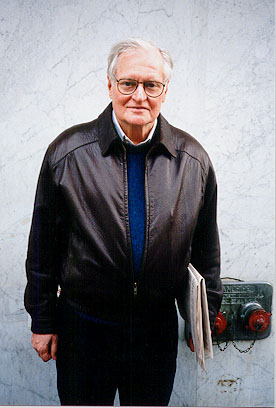
how to read john ashbery
HM: I always thought that the principle of my life was to be leaving for someplace else wherever I was and no matter where I was living.
JA: And to arrive at an unspecified date.
HM: Yes.

roussel
JA: When I first met you, you were fascinated by Raymond Roussel, whom I introduced you to, I believe.
HM: That's right.
JA: We must credit Kenneth Koch, however, for the original American discovery.
HM: Yes. I always credit him.
JA: I seldom do. That's why I was doing so now. And since then you've been involved in the Oulipo - and it seems as though the discovery of Roussel's processes and writing must have been one of the things, perhaps the most important one, that occurred at that time since you've evolved more and more towards works that are somehow schematic.
HM: This is something that had appealed to me in poetry; obviously all poets who write in traditional forms are involved in this, and I'd also invented ways of doing it in poetry myself. For instance, I wrote a long poem in sonata form. That seemed to be a thing you could do in poetry or at least try out in poetry. I was dying to write prose, but I didn't know any way of going about doing this in prose. Then Roussel showed me that you can generate prose works with the same kind of arbitrariness that you use in verse. One extraordinary thing about poetry is that, say, if you're writing couplets, every five feet you have to have a word that sounds like another word, whether that makes any sense or not. You have arbitrary, illogical demands that you have to make on yourself. Roussel showed how this can be done in prose and so for me opened up the whole possibility of writing fiction, which I'd tried before without ever getting any place. I'd always thought that to write fiction you had to write more or less autobiographical stories, or stories of things that you'd observed in the world. It's terribly hard to do that; at least it was terribly hard for me - to make it sing and glow. I think that's why Roussel excited me so.

mathews
HM: Who was it that said to Pasternak - was it Scriabin or somebody playing Scriabin?
JA: Yes, that he should simplify -
HM: No, he said that he had finally achieved utter simplicity in his last works, which were of an absolutely mind-boggling complexity.

o'hara and ashbery
JA: I once quoted that passage to somebody interviewing me who wanted some justification for my complexity, somebody not very sympathetic. She said: "Sobering thought."
HM: It's a very hard point to get across to a lot of people, that a work is much harder to get if it's diluted, whereas if you have it exactly the way it should be, it looks very thorny or cranky but in fact it just fits the space it's taking up. I'm obsessed with getting rid of words, too. Sometimes it seems to me that so much scraping takes place that words end up doing rather interesting things. Perec said when he translated me that I was very hard to translate because I used words "juste a cote leur sens" - just alongside their meaning. Since they were very ordinary words one didn't really notice this as it took place.
JA: What's the position of Oulipo in France? How's it regarded by writers in general?
HM: I went to see Michael Leiris, whom you just mentioned a few moments ago. He said, "I'm very interested in what Oulipo does, but don't you think its results are rather mechanical?" You know, he's very sly. And of course he does his whole - the "Glossaries" he makes up are very Oulipian. I think people who know it from a distance look on it with some suspicion, which is a good thing. I mean, it still has a certain ability to provoke. The position that it claims for itself is slightly suspect. We say that we invent forms (or rediscover old forms) that are very hard to use, very demanding, so that these will be available to other writers, a kind of contribution made to the potentiality . . .
JA: Very thoughtful of you.

ashbery
HM: Exactly. It's very thoughtful of us and never really happens. But I think its true activity, which is to experiment in forms rather than in writing, "is" interesting. And if it has to be justified, it's justified by the writing of Calvino and Perec, people like that.
JA: People always ask me what influence my years in France had on my work. Of course I'm capable of answering, but I've often felt that there really wasn't much influence, except that it's very nice to live in a beautiful, cultured city with very good food--surely this played as important part in it. But I never felt that French "poetry," with a few exceptions - Roussel, Rimbaud, Lautreamont, etc. . . .

rimbaud, kind of
HM: Reverdy, no?
JA: Reverdy, yes, of course-were very influential. In fact, I'm not sure how influential any of them were. I admire them; they are very great writers. But except for a few fortuitous resemblances to Reverdy or Roussel, they don't seem to have influenced me directly. It's almost as though French and English don't quite mix in a fruitful way. I heard somewhere that Stravinsky wrote his work for violin and piano - a sonata, I guess - because he always felt that the sounds of the two instruments were absolutely incompatible and wanted to see if he could address this problem.
HM: That's quite true, they go very badly together, despite the literature.
JA: It's as though French were like a violin and English, or American, were like a piano.
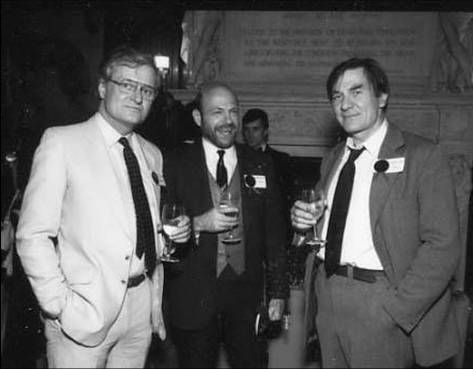
ashbery (left)
HM: So what is the question?
JA: Do you feel that your work would have been different, or do you feel that living in France has had a direct forming influence on your work?
HM: I think living away from one's country gives you a difficult privilege. You're not under the pressure of people publicly succeeding better than you at what you're interested in; you're away from that and there's a relief in that sense. And also you have to be conscious of your own language. You're forced to be conscious of your language and your writing and your attitude toward writing. As for the Frenchness of that position, I guess really- that Mallarme as an idea was always very potent for me. It wasn't that Mallarme's present-day disciples seemed like ones to emulate, but I was living in a country-
JA: The six-words-to-a-page school?
HM: Yes, there's that, and the "I'm not saying what I seem to be saying" attitude towards writing poetry. I felt that I was surrounded by language to which Mallarme had a weird relationship. Mallarme wrote like nobody else; even his letters to his friends are very hermetic and hard to read and don't sound like the language of his contemporaries or his successors or his predecessors. So that reading Mallarme or Roussel, for whom these comments are true also, in France is inspiring, and in the fact that he has become the father or grandfather of modern poetry there is something that I could look to for inspiration. I think that would have been harder to do if I'd stayed here. For the personal reasons we talked about earlier - we didn't talk about them so much - those reasons why I didn't want to come back to the United States: since I'd taken refuge in France the way I'd taken refuge in poetry earlier in my life, it seemed appropriate that there was this utterly committed writer, someone who had gone to an extreme that no writer I know in English had ever done-towards formality, a kind of abstraction.

o'hara, larry rivers, some other peeps
JA: I always felt that what you say about Mallarme was true of surrealism - that idea of it was actually more important than the works it resulted in. I don't know whether you were saying that about Mallarme.
HM: No, I love Mallarme's poetry. And I agree with you about surrealism. Maybe you're thinking more of what has been made out of Mallarme than what he actually . . .
JA: No, I was putting words in your mouth. I thought that's what you were saying.
HM: I don't know that I'd ever actually like to write like Mallarme.
JA: No.
HM: But I think it's wonderful that somebody did. He seems to have gone much farther than the surrealists, getting to the bottom of the French verse and the French sentence. I think poems like "Le Don du poeme" are extremely moving and irremediably - if that's the word - mysterious.
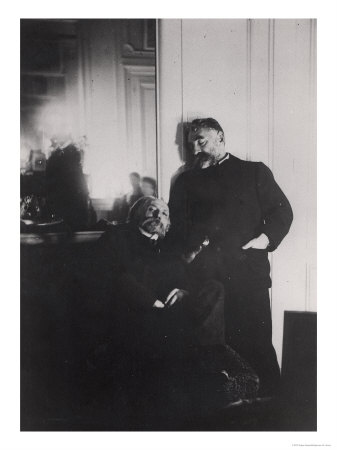
renoir & mallarme
HM: Is there any kind of final thing I could tell you about myself that has been mysterious to you through all these years?
JA: Well . . .
HM: It's been a very long friendship.
JA: Don't speak as though it were over, please. One of the minor mysteries of your activities is how you decide how long you're going to spend in one of your three places.
HM: I sort of schedule it knowing that after a certain time, after a few weeks, I'll grow attached to the place, so that I always manage to leave when I'm longing to stay a little more. But I'm never sorry to get to the place that I move on to.
From the "Review of Contemporary Fiction," Fall 1987, Volume 7.3
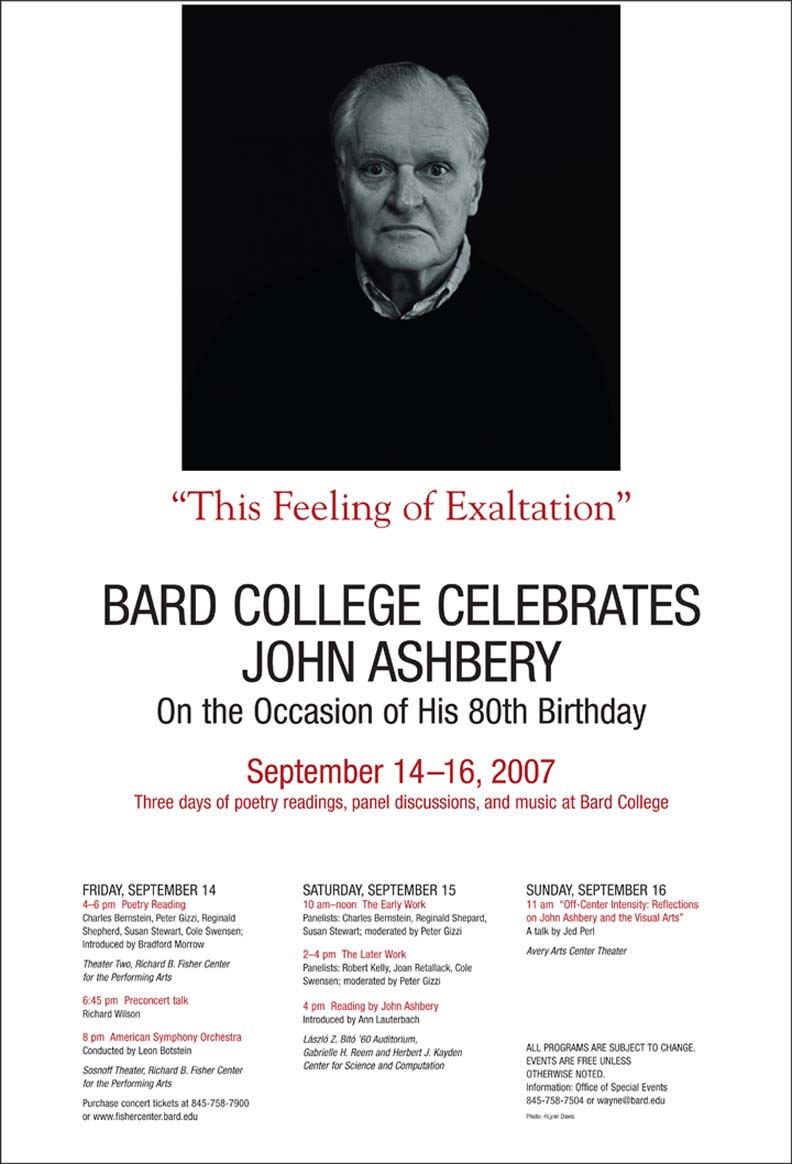
YOUR WEEKEND PLAYLIST OF INTENTIONAL MUSICALITY

preorder Elephant Shell here
"Your English Is Good" - Tokyo Police Club (mp3)
"Fatalist Palmistry" - Why? (mp3)
"Rope of Sand" - Jamie Lidell (mp3)
"Could We Survive" - Joseph Arthur (mp3)
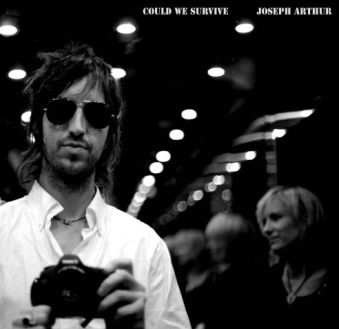
buy the ep here
"We Can't Help You" - Stephen Malkmus (mp3)
"Been So Long (Neighbors remix) " - Vetiver (mp3)
"Athene" - Hercules and Love Affair (mp3)
PREVIOUSLY ON THIS RECORDING
A.C. Hawley on Kim Kardashian and other reality TV whores
Alex on I Am Legend
Brenda Cromb takes the Coen Brothers to school

ashbery